
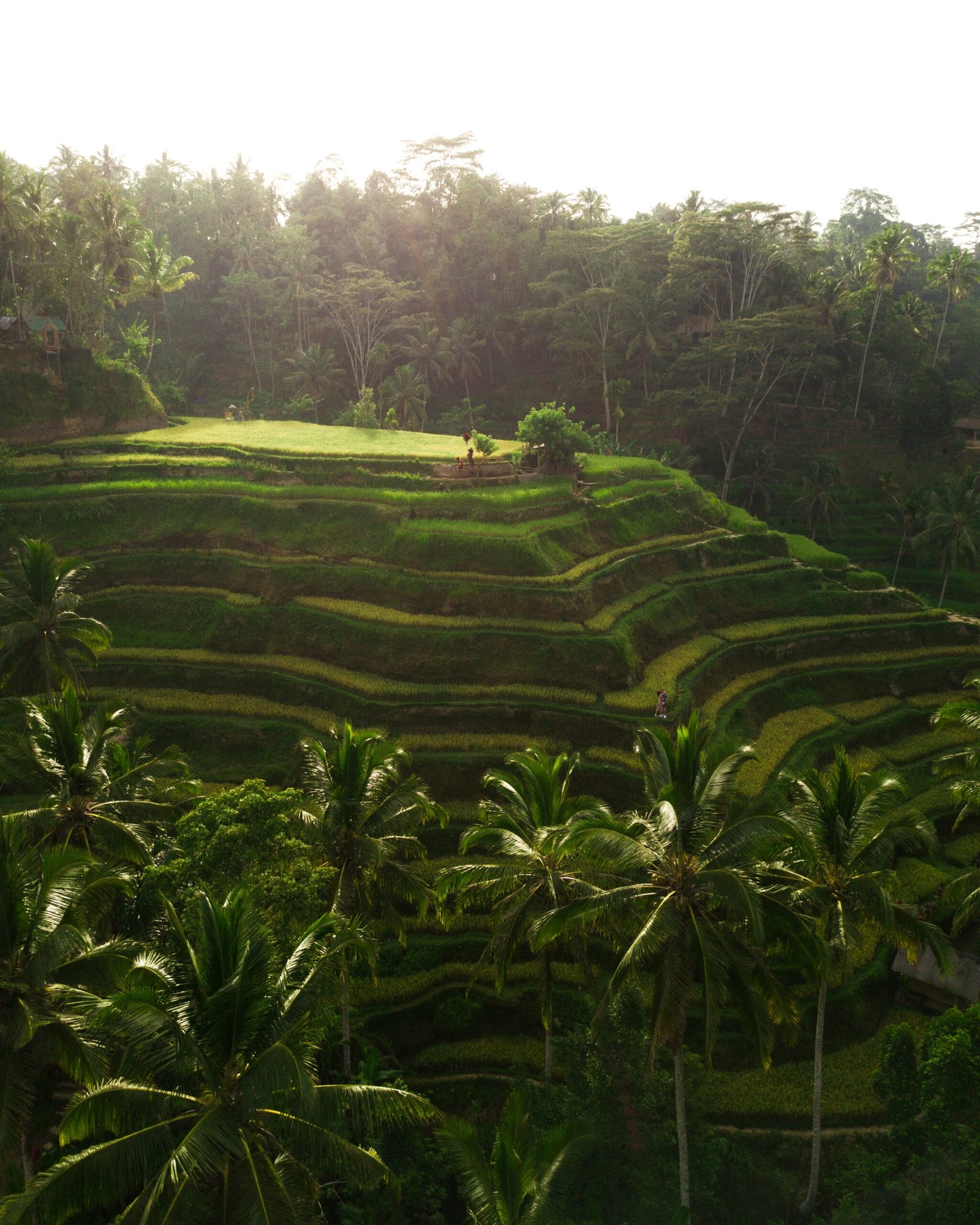
Last Friday the moon went dark over Bali. Tilem, the new moon, fell on the same day as Hari Bhatara Sri — the day we set aside for Dewi Sri, the goddess of rice. In villages around Ubud, offerings appeared at the edges of the paddies before sunrise, and farmers paused their work to give thanks for the crop that feeds the island.
Dewi Sri is the goddess of rice and fertility, honoured across Bali and Java. Rice here is never treated as a simple commodity. It is understood as her gift, and every stage of its growth — planting, flowering, harvest — is marked with prayer. To waste rice is, in the old way of thinking, a small discourtesy to her.
Walk any path through the rice terraces and you will pass them: small shrines standing among the paddies, often no taller than a person. This is where farmers leave their offerings for Dewi Sri. They are easy to mistake for decoration. They are, in fact, the reason the fields around you look the way they do — tended, returned to, cared for.

The terraces themselves are held together by subak, a centuries-old system in which farmers share and govern water together, guided by the temples upstream. It is so central to Balinese life that UNESCO recognised it as a World Heritage cultural landscape in 2012. The green steps you see from a villa terrace are not a natural accident; they are the work of generations cooperating around a single stream.
Go early, before the heat. Look for fresh offerings on the shrines, the narrow channels that carry water from one terrace to the next, and the farmers who start work at first light. Greet them, keep to the paths, and step around the offerings. You will see the same fields everyone photographs — but you will understand what you are looking at.
Several Aligna Hospitality stays sit within walking distance of Ubud’s rice terraces. Find the one that suits your pace.